
William Wilberforce

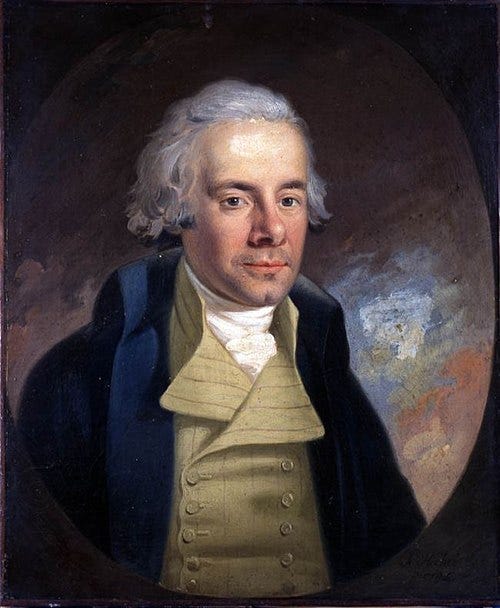
Introduction
“As soon as ever I had arrived thus far in my investigations of the slave trade, I confess to you, sir, so enormous, so dreadful, so irremediable did its wickedness appear, that my own mind was completely made up for abolition…Let the consequences be what they would: I from this time determined that I would never rest until I had effected its abolition.”
— William Wilberforce
By the late eighteenth century, roughly twelve to thirteen million people were enslaved worldwide. About half lived in the Americas — on Caribbean plantations, in the fields of Brazil, and throughout the young United States — while around five million remained in bondage within Africa itself, and several million more across the Ottoman and Indian Ocean worlds.
In the transatlantic slave trade, which sent people from Africa to the Americas, Britain had become one of the dominant powers, controlling roughly one-third of all slave voyages crossing the waters. Between 1662 and 1807, British ships alone transported an estimated 3.1 million Africans.
This generated immense wealth. British port cities thrived on slave cargoes and plantation goods. Many professions, including bankers, insurers, shipbuilders, and textile manufacturers, all profited from the trade. Slavery was a pillar of British prosperity.
But the voices against Britain’s participation in slavery were growing. And chief among them was that of William Wilberforce. He would devote nearly his entire adult life to abolishing slavery throughout the British Empire.
To challenge such an entrenched system was to confront the very centers of wealth and power in Britain. But challenge it, he did. And he succeeded in time. He would also live just long enough to see his mission fulfilled, with Parliament voting to abolish slavery throughout the British Empire just three days before he died in 1833.
Early Life
William was born on August 24, 1759, in Hull, a busy port town in northeastern England, where his father worked as a prosperous merchant. The family was well off and able to provide the comforts he needed. Yet worry marked these early years. William was frail and often ill. Doctors doubted he would survive childhood.