
Wilhelm & Bertha Röntgen

For six weeks, Wilhelm Röntgen went to his laboratory without telling anyone what he was working on. When his wife asked him, he said only that if people knew what he was doing, they would say he had gone mad.
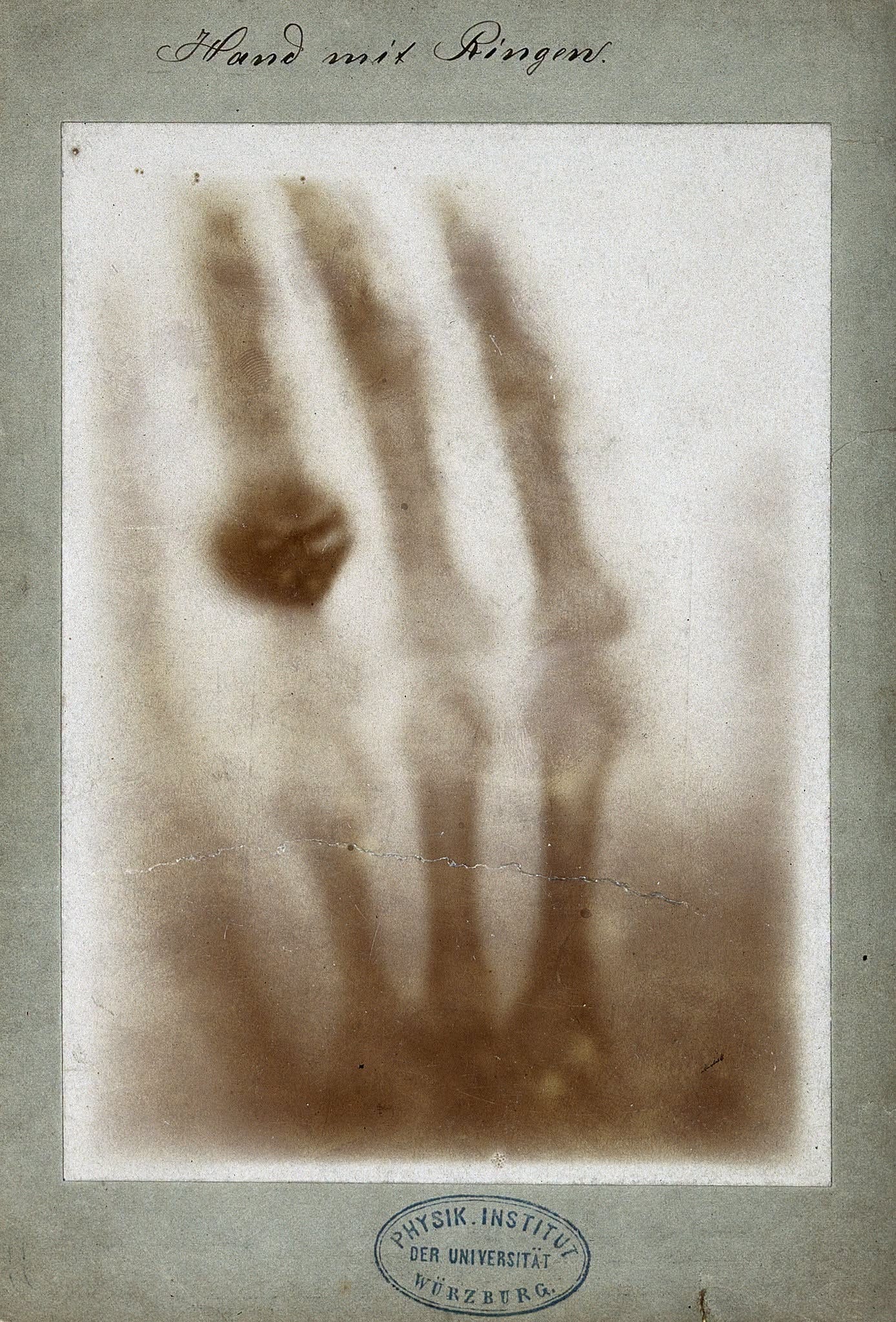
Then, on December 22, 1895, he asked her to lay her hand on a photographic plate and hold it still. Bertha Röntgen held it there as he asked.
When the plate was developed, the bones of her hand could be seen inside the faint shadow of her flesh, with her wedding ring dark around one finger.
What Wilhelm created that day was the first photograph ever taken of the inside of a living person. Not knowing what the rays were that had passed through her hand to create the image, Wilhelm had called them X, the letter mathematics uses for an unknown quantity. The name stuck.
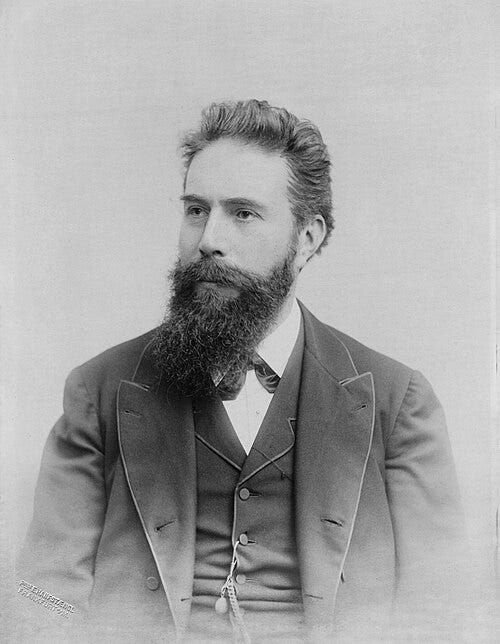
Bertha and Wilhelm Röntgen first met during Wilhelm’s student years in Zurich, at an inn kept by her father, Johann Ludwig, who had settled in the city from central Germany after fleeing the university town of Jena in the 1830s for his politics, having been barred from school and nation alike. He had followed the path of many other German political exiles, who were finding positions at the Polytechnical School in Zurich. Johann, however, didn’t have the same success and went into innkeeping to make a living.
One’s work isn’t always defined by the title of a profession. Since his inn stood near the school, students would come to drink and debate. Johann took to teaching them there. He helped them study for exams and write their theses in Latin, which the university still required, and built a fencing hall behind the inn to teach them the art. Wilhelm was one of those students.
Like Johann, Wilhelm had come to Zurich with doors closed behind him. He arrived in 1865, expelled from the technical school in Utrecht, Holland, for refusing to give up the name of the boy who had drawn a caricature of a teacher. The expulsion cost him the school-leaving certificate, without which no Dutch university would admit him. There was one exception — a special examination by which a student without the certificate could still qualify. Wilhelm prepared for it. But on the day of the examination, the professor who was to conduct it fell ill, and in his place sat one of the teachers who had helped expel Wilhelm. Wilhelm failed, and with that, the last route to a Dutch degree was gone.
Wilhelm’s desire for a university education eventually led him to Switzerland and the Zurich Polytechnic, which didn’t require a school diploma, and though it ordinarily demanded an entrance exam, it excused him from that as well, on account of his mature age of twenty and his admirable record at Utrecht, especially in mathematics.
At the school, Wilhelm began going to the inn, and like many students before him, he and Johann took to each other. But unlike the other students, Johann’s fondness for the pupil was shared by his second daughter, Bertha. Six years older than Wilhelm, tall, and by most accounts charming, she had been sent away as a girl to school on the far side of Switzerland from home. Her father wrote to her there that a sincere, orderly, and well-educated character was the only treasure he and her mother had it in their power to give her, and that she should know it was worth more than the kind they could not.
By the time Wilhelm arrived in Zurich, Bertha’s schooling was years behind her, and she was back at her father’s inn. Amid the general talk of the room, the two of them gravitated to one another, and over the next few years, they grew closer together, despite the busy nature of his studies and her declining health.
In the summer of 1869, when Wilhelm received his doctorate, Bertha was in a sanatorium above the city for her health. On the evening of the day his degree was conferred, the twenty-second of June, he went up to see her. What was said between them is not recorded. But they made plans to marry, which had to wait for his parents’ consent to the engagement. That came some four months later after his father had traveled to Zurich to meet her.
Wilhelm was fifty in 1895, and by then the director of the university’s physics institute. He had spent much of his career on the study of gases, crystals, and the compressibility of liquids. But for the past year another problem had piqued his interest, one physicists across Europe were researching — when an electric current ran through a glass tube in which nearly all the air had been removed, rays of some kind were produced inside it. These rays were invisible in themselves, known only by the glow they made where they struck the glass. But no one could say definitely what they were.