
Thomas Paine: Introduction

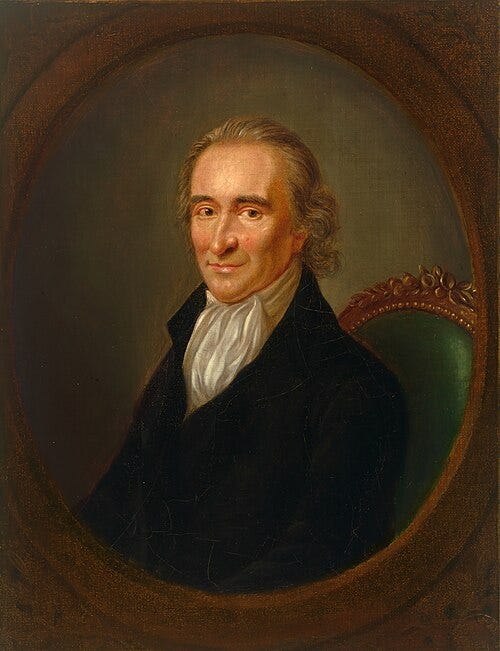
Thomas Paine arrived in Philadelphia from England at the age of thirty-seven in late November of 1774, having nearly died from typhus on the voyage and needing to be carried ashore, too weak to stand. He was an immigrant now, settling in the American colonies for the first time in his life, after years marked by tragedy and failure — having been widowed once and separated once, dismissed twice from government service, and having watched two businesses of his own fail. Now he had little to his name beyond a letter of introduction from Benjamin Franklin, who described him as “an ingenious, worthy young man” and recommended that he begin a new life in the colonies.
Franklin’s judgment would prove remarkably sound. Little more than a year later, Paine would publish a small pamphlet that helped turn a colonial rebellion, one that many Americans still hoped and believed would end in reconciliation with Britain, into a movement for independence.
That pamphlet, titled Common Sense, was published on January 10, 1776. In it, Paine made the case for independence in direct, vigorous language that carried political argument beyond the educated elite. He wrote for tradesmen, farmers, merchants, and laborers, and gave them an inspiration for their own inclusion in the government process, or what we’d today call democracy. The work spread quickly as a result, selling an estimated 120,000 copies in its first three months, with its reach far larger still, as copies circulated from hand to hand and were frequently read aloud. Paine declined to profit from the sales and allowed it to be reprinted freely, asking that the money due to him be used instead for the war effort.
In addition, writing under the pen name “Republicus,” Paine publicly called for the colonies to adopt a new name — the United States of America. Historians still debate whether he was truly first to use it; a private letter from one of George Washington’s aides had used the same phrase months earlier.
But Paine’s impact didn’t stop there. In December 1776, the Continental Army had been driven out of New York, reduced to a few thousand ragged men, and was staring at desertion issues when enlistments expired at year’s end. Many believed the Revolution was already lost.
Paine had marched with that retreat himself as a volunteer, and it was during that march that he wrote the first of what would become a thirteen-part series of pamphlets called The American Crisis, opening with the famous line, “These are the times that try men’s souls.”
He published it on December 19. Six days later, on Christmas night, Washington’s army crossed the ice-choked Delaware and won a decisive fight at Trenton the following morning, a victory that began a remarkable reversal in a campaign that had seemed all but lost. By long-standing tradition, though no firsthand account actually confirms it, Washington had Paine’s essay read aloud to his troops before that crossing.
Paine became one of the most famous men in America. Then he went to France, where he once again moved toward the center of a revolution. Granted French citizenship and elected to the National Convention, he opposed the execution of Louis XVI and urged that the former king instead be exiled to America. The stance aligned him with a political faction that soon fell from power, and as fears grew of foreign influence in a France now at war with his native England, Paine found himself dangerously exposed. He was arrested in December 1793 and sent to Luxembourg Prison.
Paine later said that he came within a chalk mark on a cell door of being sent to the guillotine. He survived because his cellmates had left the door open to cool his fever, and when the guards came to take away the condemned, the mark was on the inside, so they passed the cell by.
Shortly before his arrest, Paine completed the first part of The Age of Reason, an attack on organized religion so unsparing that it cost him much of the popularity he had once enjoyed in America. It was a fall from favor his later public break with George Washington only deepened. When he returned to the United States, a local election official refused to let him vote, claiming his years in the French government had cost him his American citizenship. Paine protested, but the decision stood.
Despite his fame and having stood near the center of two major revolutions, when he died on June 8, 1809, in a rented room in Greenwich Village, only twelve people were said to have come to his funeral.
Sources:
Bell, Richard. "BTSA: Professor Richard Bell on 'Common Sense' Thomas Paine (1776)." C-SPAN, www.youtube.com/watch?v=42U7lVigby8.
"Benjamin Franklin to Richard Bache, 30 September 1774." Founders Online, National Archives, founders.archives.gov/documents/Franklin/01-21-02-0170
Berton, Gary, and Scott Cleary. “Thomas Paine and the 250th Anniversary of Common Sense.” YouTube, www.youtube.com/watch?v=9bh8BzCLCL4.
Claeys, Gregory. "Thomas Paine." The Stanford Encyclopedia of Philosophy, Stanford U, plato.stanford.edu/entries/paine/.
Dabos, Laurent. Thomas Paine. c. 1792, National Portrait Gallery, Smithsonian Institution, npg.si.edu/object/npg_NPG.2008.5. / Wikimedia Commons, commons.wikimedia.org/wiki/File:Portrait_of_Thomas_Paine.jpg.
“Common Sense.” Encyclopædia Britannica, www.britannica.com/topic/Common-Sense-by-Paine.
Ingersoll, Robert G. “Thomas Paine.” The North American Review, vol. 155, no. 429, 1892, pp. 181–95. JSTOR, http://www.jstor.org/stable/25102425.
“Professor Richard Bell to Speak at Smithsonian on Thursday, Nov. 16th.” Department of History, University of Maryland, 15 Nov. 2017, history.umd.edu/news/professor-richard-bell-speak-smithsonian-thursday-nov-16th.
“The Coined Phrase ‘United States of America.’” New-York Historical Society, www.nyhistory.org/blogs/coined-phrase-united-states-america-may-never-guess.
“Thomas Paine’s Common Sense.” American Battlefield Trust, www.battlefields.org/learn/articles/common-sense.
“Thomas Paine and the Clarion Call for American Independence.” Featuring Harlow Giles Unger. YouTube, www.youtube.com/watch?v=ScWbEBqM4BA.
