
The Wright Brothers First Flight
Throwback Thursday Snapshot

"If we all worked on the assumption that what is accepted as true is really true, there would be little hope of advance." - Orville Wright
They were two brothers who owned a company making bicycles. On the surface, one wouldn't think of that experience as the best for attempting to solve a problem that had plagued many for years: how to create a vehicle that could fly. Yet, their work on bicycles gave them the mechanical expertise and knowledge of control and balance needed for a moving vehicle. It also provided them with the necessary funds.
For the brothers, flying had been an interest since their childhood days, after their father brought home a “helicoptere,” which was a toy that could fly. But it was around 1899 that 28-year-old Orville and 32-year-old Wilbur Wright “became seriously interested in the problem of human flight,” as Wilbur would later say.
The brothers were aware of the many risks and difficulties that would be present in the journey of building a flying machine. Wilbur wrote,
"For some years I have been afflicted with the belief that flight is possible to man. My disease has increased in severity and I feel that it will soon cost me an increased amount of money if not my life.”
Undeterred, they began with in-depth research about the thoughts and discoveries of inventors in the field. The brothers expressed much gratitude and took away many learnings from these works. But while the research was beneficial and helped guide some of their thinking, they felt it was best to simply build and try. Wilbur said about their process,
"The person who merely watches the flight of a bird gathers the impression that the bird has nothing to think of but the flapping of its wings. As a matter of fact this is a very small part of its mental labor. To even mention all the things the bird must constantly keep in mind in order to fly securely through the air would take a considerable part of the evening. If I take this piece of paper, and after placing it parallel with the ground, quickly let it fall, it will not settle steadily down as a staid, sensible piece of paper ought to do, but it insists on contravening every recognized rule of decorum, turning over and darting hither and thither in the most erratic manner, much after the style of an untrained horse. Yet this is the style of steed that men must learn to manage before flying can become an everyday sport. The bird has learned this art of equilibrium, and learned it so thoroughly that its skill is not apparent to our sight. We only learn to appreciate it when we try to imitate it. Now, there are two ways of learning to ride a fractious horse: One is to get on him and learn by actual practice how each motion and trick may be best met; the other is to sit on a fence and watch the beast a while, and then retire to the house and at leisure figure out the best way of overcoming his jumps and kicks. The latter system is the safest, but the former, on the whole, turns out the larger proportion of good riders. It is very much the same in learning to ride a flying machine; if you are looking for perfect safety, you will do well to sit on a fence and watch the birds; but if you really wish to learn, you must mount a machine and become acquainted with its tricks by actual trial."
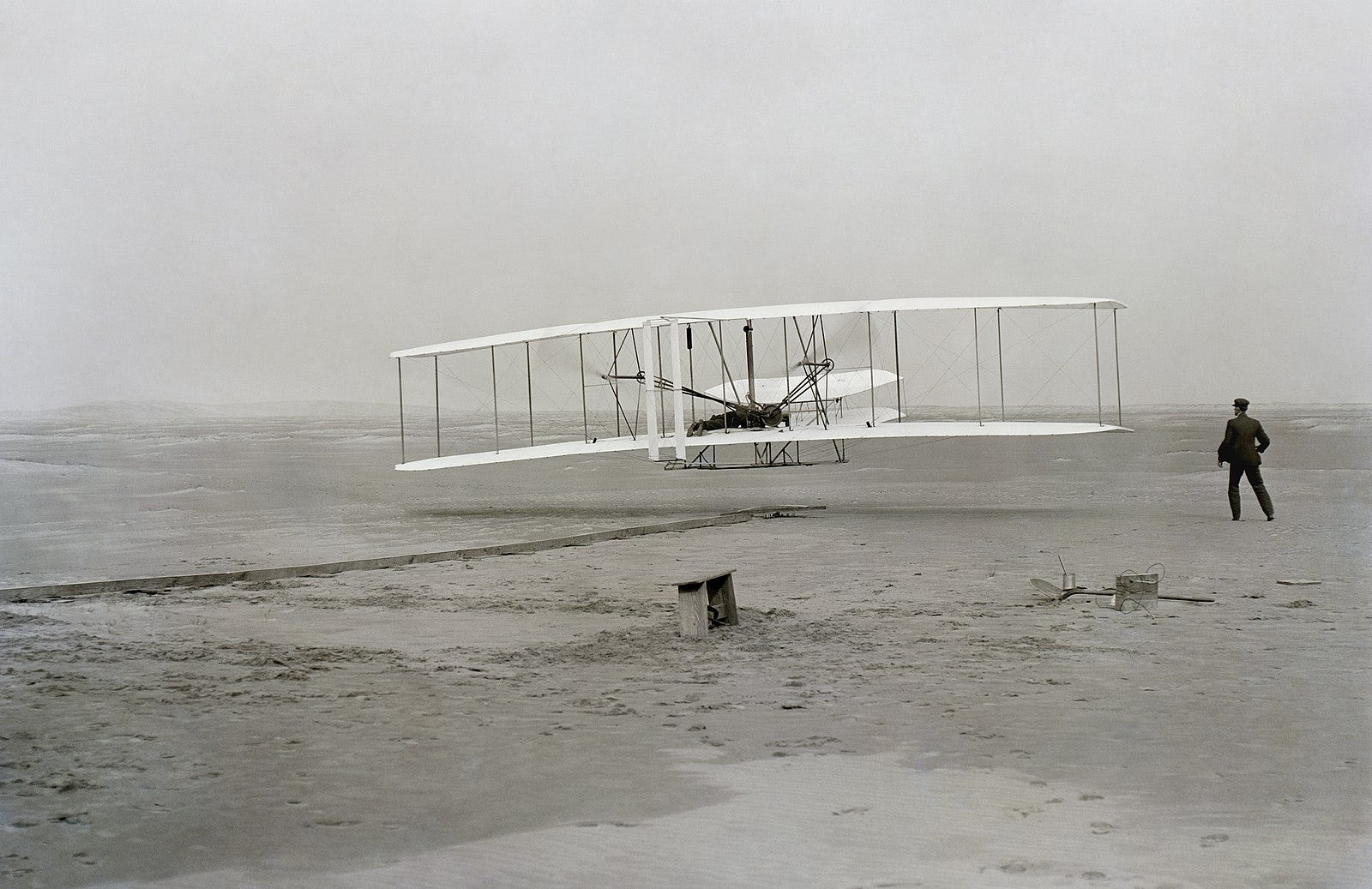
Their first manned flying experiment occurred in October 1900 at Kitty Hawk, North Carolina. They chose this location for its favorable conditions for flight experimentation. It had consistent, strong winds that could provide the necessary lift for their gliders and soft, sandy surfaces to cushion the impact of landings, reducing the risk of damage to their prototypes and injury to themselves. It was also a spot with privacy away from reporters, something both brothers deeply valued.
As for the plane’s design, it was based on principles they had tested with kites; the flight relied on the wind to stay aloft. This was a starting point, a first lesson in the air. Over the next few years, the brothers would make more than a thousand flights, gradually mastering the craft that would lead to the first successful powered flight.