
The First Official Postcard

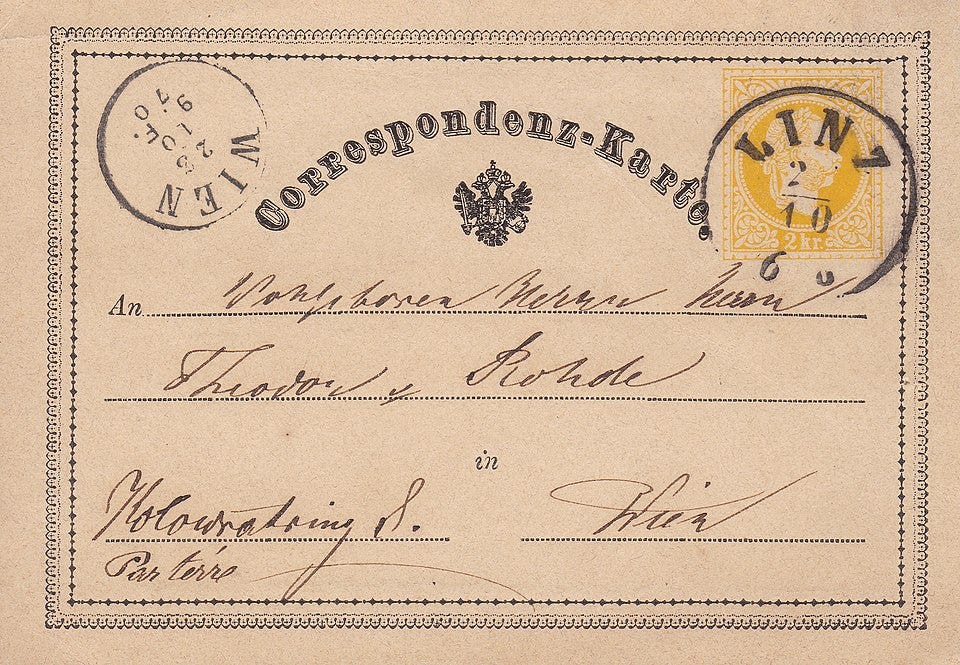
The postcard is just a slight paper rectangle that travels naked in the world — no envelope, no seal, nothing to hide the writing from all the eyes along its journey. In a way, the very notion seems a bit odd. A person’s private thoughts, meant for one reader, and yet open to all.
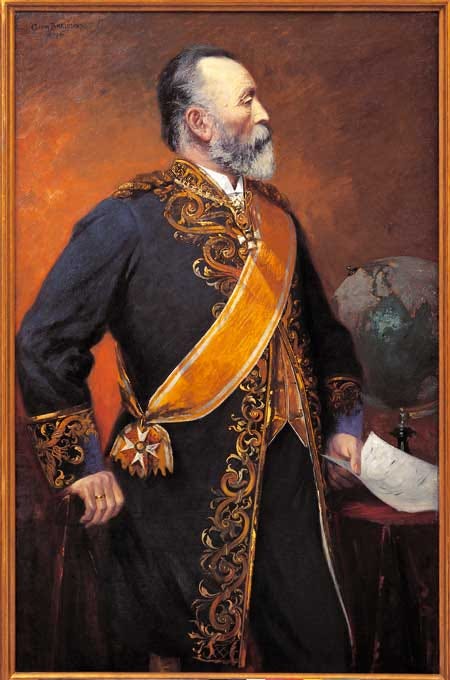
For that very reason, when a Prussian postal official named Heinrich Stephan proposed the idea to a room full of his colleagues in 1865, they turned it down. This was, by the best historical accounting, one of the first proposals for an official postcard that the post office itself would carry. And while the idea was rejected that day, it became reality just a few years later.
Before Stephan’s attempt, reaching someone at a distance meant choosing between a sealed letter and a telegram. The letter demanded full ceremonial treatment and the associated cost. Paper, envelope, postage, and the time to sit and write properly. The telegram was fast, but priced by the word and steep enough that ordinary people kept it for emergencies. A short wire could cost the better part of a day’s wage, and in the first years of the transatlantic cable, even a handful of words across the ocean cost sums ordinary people could not afford. It was also never truly yours. You didn’t write it yourself. You carried your words to an office, where a clerk tapped them onto the wire, and another at the far end wrote them out for delivery.
There was no quick, cheap, personal way to send a few unhurried words.
Few were better placed to notice this than Stephan. Since the age of sixteen, he had worked in the postal service, sorting letters in a Germany still split into seventeen separate states, each with its own rules and fees. He had spent his working life close to this problem, and he thought there should be a simpler way. Something cheaper and lighter, for a short note. Just a line or two to say you were thinking of someone.
Still, despite his conviction, the proposal failed. To the men making the decision, a card with no envelope felt improper. A telegram passed through a stranger’s hands too, but that was just the working of a distant system; a postcard was your own handwriting, carried in plain view through the world. Who, they asked, would send their words out for anyone to read?
It was a reasonable fear. But they would be proven wrong.
A good idea rarely ends on a single refusal. Such would be the case here.
The 1865 conference had been a joint Austro-German affair, and Austrian postal officials had heard Stephan make his case. The idea traveled home with them, and four years later it surfaced again in Vienna. In January of 1869, a professor of economics named Emanuel Herrmann laid out almost the same plan in a newspaper: an open card at a reduced rate for short, ordinary messages that needed no envelope. He was very likely building on what Stephan had proposed, though the exact path the idea took to reach him is unknown.
This time, however, a post office was willing to try it. On the first of October that year, the Austrian post office put the world’s first official postcard on sale. It was a small card with one side for the writing, and the other side left blank. It cost two kreuzer to send anywhere in the empire, whereas a letter required five — less than half the price, and no paper, no envelope, no ceremony at all.
Within three months, Austrians mailed approximately three million of these postcards. The idea was a wild success. Then, when war broke out between France and Prussia in 1870, the German post handed cards to its soldiers to write home. Whatever fretting about privacy there had been was long gone.
In the years that followed, a handful of inventions carried the postcard further into everyday use and shaped it into the product we know today. Printers began adding images to the blank side, a landmark or a far-off mountain, and the card became a small window onto wherever its sender happened to be. Better printing, soon including cheap color, made those images richer and more common. And continued improvements in transportation and rural delivery brought access to postcards in rural areas and worldwide. By the early years of the new century, the cards were moving in the hundreds of millions, and then the billions; in Britain alone in 1913, people mailed more than nine hundred million of them, or about twenty for every person in the country.
What the postcard did was more than lower the cost of a message. It made small communication normal. Heinrich Stephan had understood, earlier than those around him, something simple about the kind of message people often wanted to send. And while other technologies have replaced a lot of postcard use over the years, his insight into people's desire to share quick notes and images with loved ones remains central to so much of today's communication.
Sources:
Distad, Merrill. “The Postcard – A Brief History.” Peel’s Prairie Provinces, University of Alberta Library, library.ualberta.ca/peel/postcards/the-postcard-a-brief-history. Accessed 24 May 2026.
Gascoyne, Malcolm. “Evolution of the Postcard.” British Thematic Association, www.britishthematic.org.uk/find/upload/files/Gascoyne%20Rapkin.pdf. Accessed 24 May 2026.
Headlam, James Wycliffe. “Stephan, Heinrich von.” Encyclopaedia Britannica, 11th ed., vol. 25, 1911. Wikisource, en.wikisource.org/wiki/1911_Encyclop%C3%A6dia_Britannica/Stephan,_Heinrich_von. Accessed 24 May 2026.
“Postcard Collecting.” University of Maryland Libraries, exhibitions.lib.umd.edu/postcards/collecting. Accessed 24 May 2026.
Wikimedia Commons, Wikimedia Foundation, https://commons.wikimedia.org/wiki/File:Correspondenz-Karte.jpg & https://commons.wikimedia.org/wiki/File:Georg_Barl%C3%B6sius_Heinrich_von_Stephan.jpg


Very interesting
Really enjoy this history of the Postcard...I love postcards and still send them when I go away and try to fit as many words as I can when I write. Vicki RH