
Sitting Bull

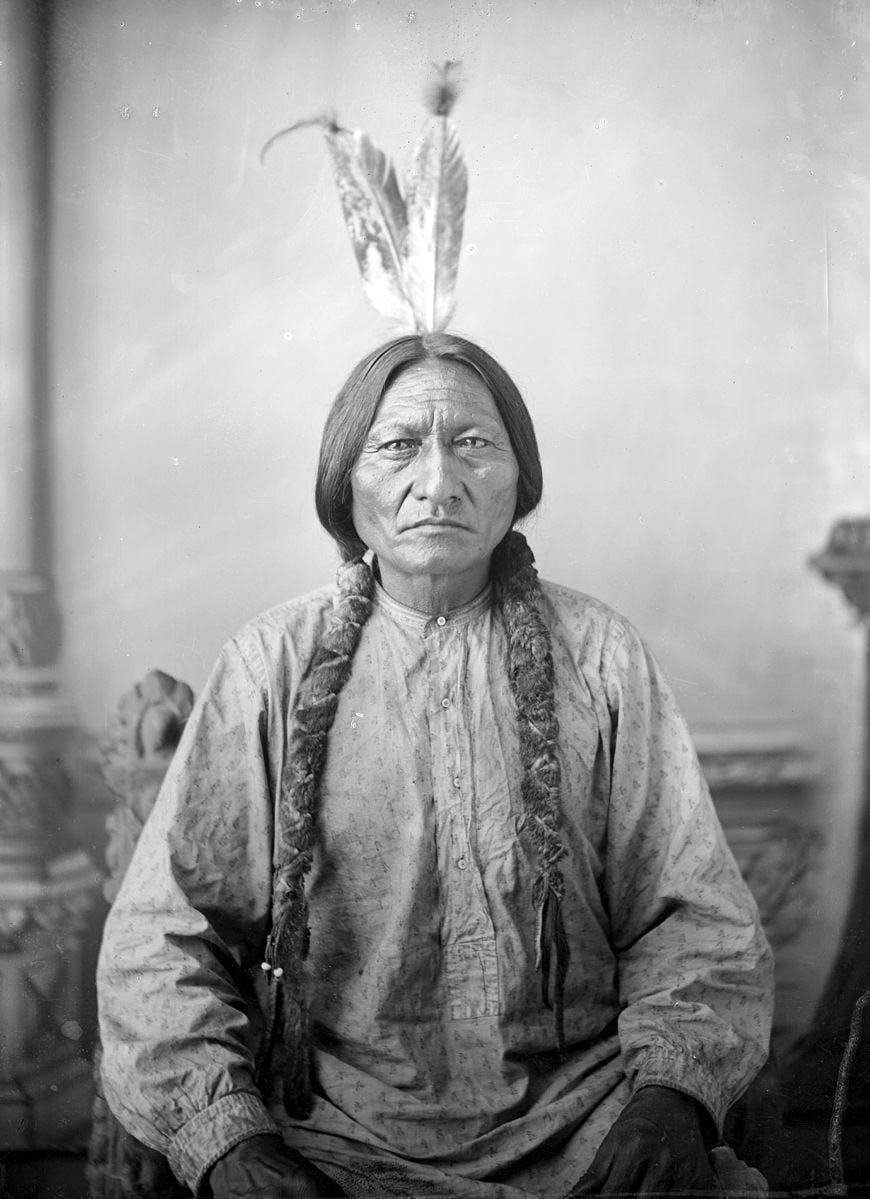
“Inside of me there are two dogs. One is mean and evil and the other is good and they fight each other all the time. When asked which one wins I answer, the one I feed the most.”
– Sitting Bull
The summer sun burned fiercely on the vast Dakota plains as an encampment of approximately ten thousand Lakota and Cheyenne Native Americans gathered along the Little Bighorn River in mid-June of 1876, their thousands of tipis forming a circle. At the center of the camp stood Sitting Bull, chief and holy man of the Hunkpapa Lakota.
At this point in his life, Sitting Bull was in his mid-40s, but already a figure of significant authority. Known for his calm judgment and spiritual power, he had resisted efforts by the U.S. to force his people onto reservations, an experience that many Native Americans had been enduring for some time. Now, with the U.S. Army closing in on the tribes, Sitting Bull turned to the Sun Dance, the most solemn ritual prayer of the plains, a sacred ceremony in which people sought visions and offered themselves in sacrifice. In Lakota belief, the suffering of one could strengthen the many, and the giving of flesh was considered the most sacred gift to Wakan Tanka, their Great Spirit.
In preparation for the ceremony, Sitting Bull had fasted and prayed to the Great Spirit for two days to give him strength on behalf of his people. Then, he entered the dance lodge, a circular space marked by a central pole rising like the axis between earth and sky. He braced himself as wooden skewers were pushed through the skin of his chest and fastened to thongs tied to the pole. As singers chanted and drums thundered, he leaned back and pulled against the cords. From his body, he cut pieces of flesh, one after another, giving them as sacred offerings to Wakan Tanka.
At last, Sitting Bull collapsed, weakened from fasting and pain. As he lay still, he entered a vision. When he rose, he told the people he had seen soldiers falling into camp upside down, like grasshoppers from the sky. The people understood this as a prophecy of victory in the battle ahead.
About a week later, that vision seemed fulfilled at the Battle of the Little Bighorn, when George Armstrong Custer and more than 200 soldiers in his command fell beneath the combined forces of Lakota, Cheyenne, and Arapaho warriors.
The Sun Dance of June 1876 became one of the most memorable ceremonies in Lakota history, often referred to in later accounts as “Sitting Bull’s Sun Dance.”
Sitting Bull was born in the windswept plains of what is now South Dakota sometime around 1831 into the Hunkpapa band of the Lakota Sioux, one of the most powerful peoples of the Great Plains. His father, known in translation as Returns-Again, was a respected warrior known for his bravery, and his mother, Her-Holy-Door, was remembered as a woman of dignity whose patience and steadiness left a deep impression on her son.