
Robert Smalls

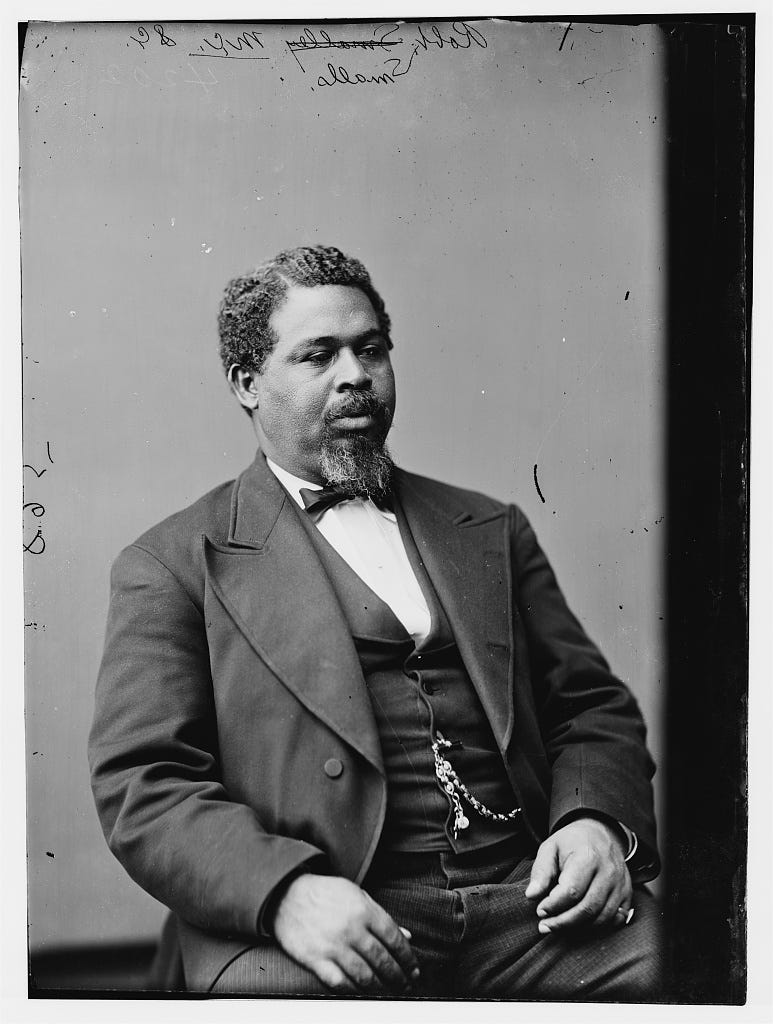
On the night of May 12, 1862, the three officers of the Confederate steamer the Planter went ashore in Charleston, South Carolina, to sleep, leaving the ship in the care of her enslaved crew. This was against standing orders, but they had done so before, and nothing had ever come of it.
Left at the helm was twenty-three-year-old Robert Smalls. He had been waiting for a night just like this.
Robert had been born in Beaufort, South Carolina, on April 5, 1839, behind the house at 511 Prince Street, where his mother, Lydia Polite, was enslaved to Henry McKee. The boy grew into something of a favorite in the household; he ate well and played with the McKee children. But that kindness worried his mother. She understood what the boy could not yet: that kindness had no standing in the law that owned him. So she made certain her son saw slavery whole, the auctions and the whippings along with the warm house, and never grew up mistaking being treated well for being safe.
When Robert was twelve, at his mother’s urging, McKee hired him out in Charleston, where the boy went to work as a hotel waiter and a lamplighter, then down on the docks loading and unloading cargo, and finally aboard the harbor’s vessels as a rigger and sailor. Of the wages he earned, he was allowed to keep only a small share; the rest went to McKee. Eventually, he arranged to hire his own time, paying McKee a fixed monthly sum and keeping what he made beyond it.
But more importantly in the long run, the work gave him a love of and knowledge of the water. Robert became a wheelman; the title of pilot was reserved for white men, but the distinction was in the name only. By his early twenties, there were few men who knew Charleston Harbor, or how to handle a ship on it, as well as Robert Smalls did.
In 1856, Robert married Hannah Jones, an enslaved woman. They had a daughter, Elizabeth, and later a son. A family now, and not one member of it his own in the eyes of the law. In time, Robert arranged with Hannah’s owner to buy their freedom for eight hundred dollars. Saving toward it, however, was slow work on what little he was allowed to keep, and an enslaved family could be sold apart long before such a sum came together. Somewhere in that gap, between the money he had and the money he needed, it is fair to suppose, an escape plan was born. It needed only the right circumstances.
By 1861, Robert was wheelman of the Planter, a 147-foot cotton steamer the Confederates had put into service to carry troops and supplies, lay torpedoes, and survey the coastal waters. She worked the harbor and its defenses, and her officers came to rely on their enslaved wheelman. As a result, he knew the signals that passed a vessel through the Confederate checkpoints. He knew, too, where the torpedoes lay, for the Planter had helped set them. And because the officers spoke freely in front of him, he came to know how the harbor’s defenses were arranged. Robert also noticed something else. Some nights, Captain C.J. Relyea and his officers went ashore to sleep at home with their families.
That’s what they did on the night of May 12, 1862.
Robert was ready for the moment. In the weeks before, he and the other enslaved crewmen had met in secret and settled on a plan, with all but two agreeing to follow him and be ready the moment a chance arose. All they lacked was a night when every officer slept ashore. Now they had one.
At about three o’clock the next morning, the Planter eased away from her wharf with her enslaved crew aboard and Robert at the wheel, wearing the captain’s wide-brimmed straw hat. At a wharf nearby, they took aboard Hannah, the children, and others who had chosen to risk it. Sixteen people in all. Everyone understood the terms. Hannah had given her answer weeks before, when Robert first told her the plan, and she asked what would happen if he were caught. “I shall be shot,” he told her. “It is a risk, dear,” she answered, “but you and I, and our little ones must be free. I will go, for where you die, I will die.”