
Mary Somerville

Hi all: a quick announcement before today's story.
The Mary Kies snapshot from earlier this month is now available in the Historical Snapshots store as a handwritten letter — something new I'm trying. I've been exchanging physical letters with friends in recent months and have been surprised by just how much of a joy it is.
Each Mary Kies letter is handwritten by me after you order, and the form includes a field for personalization if you'd like to send the story as a gift.
Thank you, as always, for reading and supporting Historical Snapshots. A discount code for the Historical Snapshots store is available for paid subscribers after the story below.
— Roman
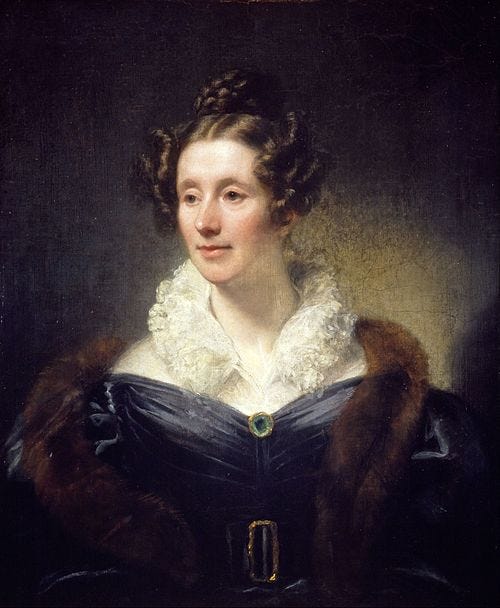
When Mary Somerville died in Naples, Italy, in November of 1872, just shy of her ninety-second birthday, a newspaper sought a sentence to capture her legacy. “Whatever difficulty we might experience in the middle of the nineteenth century in choosing a king of science,” the obituarist wrote, “there could be no question whatever as to the queen of science.” It was a fitting line for an age that had only just invented the word scientist — a word, as it happened, first printed in a review of one of Mary’s books. It was a simple description of her extraordinary life.
Mary was born in Jedburgh, Scotland, in December of 1780, but her childhood was spent largely in Burntisland, a small seaport on the coast of Fife, where her father, a naval officer, was away at sea for long stretches, and her mother took care of the home. Here, Mary’s schooling barely existed in any formal sense. Instead, “My mother taught me to read the Bible,” Mary remembered, “and to say my prayers morning and evening; otherwise she allowed me to grow up a wild creature.” The latter statement meant spending her hours exploring outdoors, gathering shells and watching birds, learning the names of plants she found in the rocks, studying the stars from her bedroom window with the help of a small celestial globe.
But when Mary was nine, her father came home from a long voyage and was startled by what he found. His daughter could read but barely write, and no one had taught her arithmetic. “This kind of life will never do,” he told her mother. “Mary must at least know how to write and keep accounts.”
So the following year, she was sent away to a boarding school. It was an experience that Mary despised. The school enforced posture by physical means. Each girl was laced into a stiff corset with a steel busk down the front; cloth bands pulled her shoulders back until the shoulder blades met; a separate steel rod, fitted with a curved brace under the chin, held her head upright. The children were expected to do their lessons in this apparatus. “I was utterly wretched,” Mary later wrote of the year that followed. “The change from perfect liberty to perpetual restraint was in itself a great trial.”
She was brought home after just one year. Whatever the school had meant to teach her, it had not taken. She returned to Burntisland and to her own studies, which she now pursued with more seriousness than before. Looking back as an old woman, she explained what had hardened in her during those years and the ones that followed: “I was intensely ambitious to excel in something, for I felt in my own breast that women were capable of taking a higher place in creation than that assigned to them in my early days, which was very low.” So she taught herself. Shakespeare, the night sky, and Latin from a textbook she found at home — these became her real schooling.
Then came a tea party when Mary was about fourteen that would change the course of her life.