
Katherine Johnson

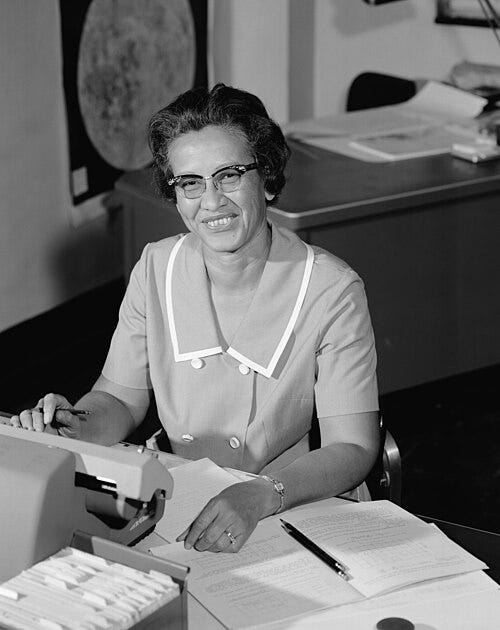
In 1962, as John Glenn prepared to become the first American to orbit Earth, a quiet, unassuming mathematician was called upon for a final check. NASA’s new computers had run the orbital trajectory, but Glenn preferred to put his life in the hands of a human — one specific person. “Get the girl to check the numbers,” he reportedly said. That “girl” was Katherine Johnson.
Katherine was in her early forties then, a black woman working in a time that often doubted both her race and gender. But no one questioned why Glenn was asking for her confirmation. She was known for her brilliance and attention to detail.
She manually verified the trajectory calculations by hand, checking the computer’s results line by line. When she gave her approval, Glenn smiled and said, “If she says they’re good, then I’m ready to go.” And history was made.
It was one of the defining moments of the Space Race between the U.S. and the Soviet Union and of Katherine Johnson’s extraordinary career.
“I counted everything. I counted the steps to the road, the steps up to church, the number of dishes and silverware I washed … anything that could be counted, I did.” - Katherine Johnson
Katherine was born in 1918 in White Sulphur Springs, West Virginia, the youngest of four children in a family that deeply valued education. Her parents set what seemed to many an impossible goal: all four children would go to college. At the time, few Americans, and almost no black Americans, did. But even before the challenge of college came that of K-12 schooling. The school for black students in town only had two rooms for seven grades. And there was no high school. Katherine’s family eventually moved about 100 miles so their kids could have access to education.
Yet, amidst this environment, Katherine’s father, Joshua, a man of strict principles, taught his children to face the world without fear or bitterness. As Katherine would later say about racism,
“I didn’t have time for that. My dad taught us ‘you are as good as anybody in this town, but you’re no better.’ I don’t have a feeling of inferiority. Never had. I’m as good as anybody, but no better.”