
Grazia Deledda

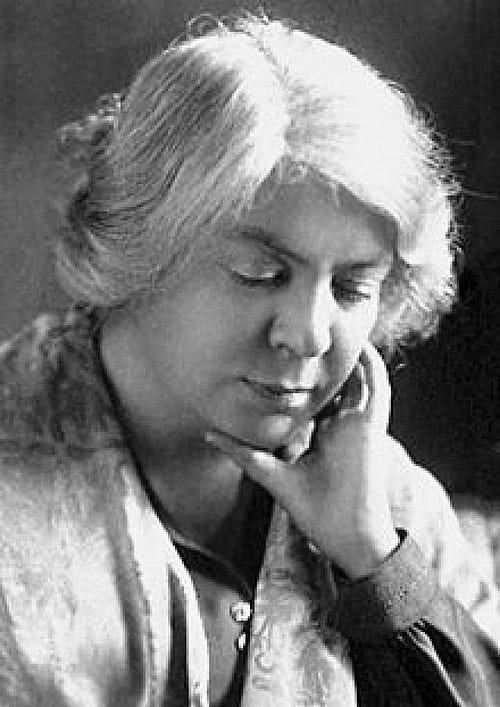
Her writing career began as a teenager in a small countryside town tucked away within a mountainous region of Sardinia. It is a great irony that nearly everyone who lived there at the time was illiterate. And yet, she would go on to write thirty-three novels, and about 250 short stories and articles. In time, she would be celebrated as one of Italy’s greatest writers, and one of the world’s, earning the Nobel Prize in Literature.
Her name was Grazia Deledda.
Grazia was born on September 27, 1871, in Nuoro, Sardinia, a place she would later describe as “a village of the Bronze Age.” She was a shy, observant child with only a modest education, attending school for just four years, which was typical for a girl at the time. She did, however, receive private lessons in Italian, and at home she was surrounded by lively storytelling that shaped her imagination.
Her father, Giovanni, was a landowner, educated and respected in town. He loved poetry, and perhaps this left an impression on his daughter. Grazia was still a young girl when he died, and his loss brought a long period of mourning over the household. It was during this heavy time that she began to write. Writing may have been part healing, part expression, and possibly part an attempt to remain connected to her father.
Whatever the reasons, her talent was evident. At thirteen, a teacher encouraged Grazia to submit one of her stories to a local newspaper. It was published, likely a thrill for her but also a shock to the small, conservative community, where the idea that a young girl would publish for the public eye was scandalous. She found herself the subject of gossip, criticized at home, ostracized by some neighbors, and even ridiculed by others.
But the criticisms didn’t stop her. She kept writing. What began in the solitude of mourning slowly became her calling. She continued working on her craft over the next few years and published her first novel at the age of 19. By her twenties, her work was appearing more widely, and she had already found her subject: the people, life, and landscapes of Sardinia.
In a later reflection about both these early years of writing and the foundation they set for her as a writer, she said:
“When I began to write, was I not using those materials which were at hand? If I continued to use this material for the rest of my life it is because I knew who I was when I grew up, tied as I was to my people: and my soul was linked with theirs, and when I peered into my characters’ souls it was into my own soul that I was looking and all the agonies that I have told on thousands of pages in my novels were my own suffering, my own pain, my own tears shed in my tragic adolescence. This is my secret!”
Though rooted in life on the island, her novels explored deeper themes that found readers far beyond Sardinia. One of the fundamental struggles of life that Grazia delved into was the theme of tension between old traditions and new ideas. Places like Sardinia represented cultures where ancient customs and honor codes shaped daily life. Yet, these were also times of change. Movements pressed for rights, and new technologies created possibilities. Her characters were caught in this struggle.
Layered into these stories was another theme: the idea of fate. Many of her characters seemed to live as though their lives were shaped by forces beyond their control. That sense of destiny gave her writing a gravity as her characters still wrestled, questioned, and searched for ways to adapt or make peace with their lives. Her characters felt achingly human because they carried the same questions as her readers often did: How to make choices, particularly in a world that often resists change?
For Grazia, this was also a profoundly personal matter. She had defied custom to become a writer. Then, in 1899, she left Sardinia for Rome, another audacious step for a woman from the island. It also led to more life changes for her. She met Palmiro Madesani, who became her husband. While this was certainly traditional, their marriage was not. Palmiro encouraged her work and gave her the space and support to write.
The worldwide appeal of Grazia’s stories led to her greatest recognition. In 1926, she became the first Italian woman to receive the Nobel Prize in Literature. The Swedish Academy praised her “idealistically inspired writings which with plastic clarity picture the life on her native island and with depth and sympathy deal with human problems in general.”
In classic Grazia fashion, her response to such recognition was characteristically modest. She didn’t seek the spotlight; she simply kept writing, returning again and again to the people and places that had always been her source of inspiration, and would continue to do so until she passed away on August 15, 1936, at age sixty-four.
Note: the Raoul Wallenberg biography book is now available for purchase in print. Paid subscribers can read the full digital version here.
Sources:
ARSENOVICH, CLARA FIANDACO. “‘Cosima’ By Grazia Deledda: Nobel Prize Winner, 1926.” Italian Americana, vol. 4, no. 1, 1978, pp. 53–64. JSTOR, http://www.jstor.org/stable/29775938. Accessed 27 July 2025.
Balducci, Carolyn. A Self-made Woman: Biography of Nobel-prize-winner Grazia Deledda. United States, Houghton Mifflin, 1975.
“Grazia Deledda.” The Nobel Prize, https://www.nobelprize.org/prizes/literature/1926/deledda/facts/
Gunzberg, Lynn M. “Ruralism, Folklore, and Grazia Deledda’s Novels.” Modern Language Studies, vol. 13, no. 3, 1983, pp. 112–22. JSTOR, https://doi.org/10.2307/3194185. Accessed 27 July 2025.
Wikimedia Commons, Wikimedia Foundation, https://commons.wikimedia.org/wiki/File:Grazia_Deledda_1926.jpg
