
Fanny Crosby

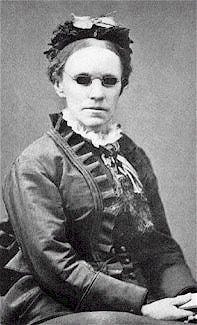
Fanny Crosby never saw her blindness as a tragedy. In her own words:
"It seemed intended by the blessed Providence of God that I should be blind all my life, and I thank Him for the dispensation. I was born with a pair of as good eyes as any baby ever owned; but when I was six weeks of age, a slight touch of inflammation came upon them: and they were put under the care of a physician.
What he did to them, or what happened in spite of him, I do not know, but it resulted in their permanent destruction, so far as seeing is concerned; and I was doomed to blindness all the rest of my earthly existence.
I have heard that this physician never ceased expressing his regret at the occurrence; and that it was one of the sorrows of his life. But if I could meet him now, I would say, 'Thank you, thank you—over and over again—for making me blind, if it was through your agency that it came about!'…
One is, that I know, although it may have been a blunder on the physician’s part, it was no mistake of God’s. I verily believe it was His intention that I should live my days in physical darkness, so as to be better prepared to sing His praises and incite others so to do. I could not have written thousands of hymns—many of which, if you will pardon me for repeating it, are sung all over the world—if I had been hindered by the distractions of seeing all the interesting and beautiful objects that would have been presented to my notice.”
—Fanny Crosby
Fanny was born on March 24, 1820, in the town of Southeast, New York. Just six weeks later, her eyes became inflamed, and the local doctor prescribed a poultice that left her permanently blind. Barely a year later, her father died.
Yet, amidst the challenges and tragedy, Fanny's mother, Mercy, and grandmother, Eunice, resolved to give Fanny a good life and ensure that blindness would not mean helplessness. Mercy worked long hours as a maid in nearby towns to keep food on the table, while Eunice took on the responsibilities of daily care of Fanny.
For the young girl, her grandmother became a teacher and conduit to the world. Eunice described objects and experiences to her granddaughter, and Fanny, with her extraordinary memory, stored them all away. She would later say that these vivid descriptions and the discipline of memorization were the foundation of her imagination. Mercy’s influence was just as significant, but in a different way. She embodied endurance, perseverance, and a diligent work ethic. And while Fanny would go through life positively about her challenges, she still experienced sorrow and struggle, even while meeting them with faith.
Two other significant developments took place in Fanny's early years. The first was that she began studying the bible, which would lead to a lifelong devotion to religion and faith. The second was that she began writing and composing short hymns. She composed her first at the age of eight. It went:
Oh, what a happy child I am,
Although I cannot see!
I am resolved that in this world
Contented I will be.
How many blessings I enjoy
That other people don’t!
So weep or sigh because I’m blind,
I cannot, nor I won’t!
At fifteen, Fanny excitedly entered the New York Institute for the Blind. She later wrote about learning that she was going to attend school:
"Only a few words, but what a flood of joy they admitted to the poor sad little soul that had so long pined and prayed for knowledge! God had responded to my prayer, at last—through His own means, and by His own faithful helpers. Oh, if the founders and sustainers of such institutions could only know a millionth part of the joy they cause, they would feel repaid for their money and their efforts—again and again!"