
Sarah Winnemucca

Violence spread across the Great Basin of the United States in the early 1870s, as the U.S. Army attacked Native American tribes. While this wasn’t new, as the relationship between the two groups had been fraught for much of their shared history, this wave of battles marked a particularly volatile time. Westward expansion of Americans accelerated in the spirit of Manifest Destiny. At the same time, the lingering pull of the California gold rush and related mining booms continued to draw settlers across native lands.
Still, conversations between the groups were needed. And the U.S. government turned to a young woman who had already spent many years working to bridge the two worlds. Her name was Sarah Winnemucca.
Sarah was born in 1844 to a Paiute Native American family in what is present-day Nevada. She was the daughter of a prominent tribal leader who often served as a spokesperson and negotiator with U.S. authorities. In general, the family believed in the importance of rooting itself in their ancestors’ ways while also learning the customs, language, and culture of the U.S. To achieve this balance, Sarah lived for periods among white families, where she learned English and Spanish and gained a deeper understanding of American society.
These languages came into use beyond daily interactions by Sarah’s early adulthood as she became an interpreter between U.S. government officials and leaders of the Paiute tribe. She translated at meetings where negotiations took place — negotiations intended, at least on paper, to establish peace. They didn’t prove fruitful.
The Paiute, like other tribes, were being forced onto reservations, where conditions consistently deteriorated. The agents assigned by the U.S. government to manage the reservation were notorious for their malfeasance. Corruption ran rampant, with food and supplies allocated for Paiute families frequently stolen or mishandled. Hunger spread among the people as a result. These agents also undermined traditional structures of authority, in which administration was rooted in consensus rather than centralized control. This effectively created an absence of leadership and autonomy.
Sarah wanted to help her people. But ironically, though she could bridge the two societies, neither fully trusted her as a result. She was too native to be reliable for some U.S. government officials. While to some within her own community, she seemed too enmeshed in a system that brought only harm. But she was learning more about what peace between the two groups might require and the care the U.S. government would need to provide to get there. And so she continued advocating.
In 1883, Sarah published Life Among the Piutes: Their Wrongs and Claims. It is a historical marker as the first book written in English by a Native American woman. But its place in history is much more significant. In the book, Sarah writes about Native American life and culture. She humanizes a community that had been depicted for so long as savage or an enemy. She also documents broken treaties, corruption, and the neglect of native customs, arguing that outcomes stemmed from these problems, which were foreseeable consequences of policies that deprived communities of independence. Communities couldn’t nor should they be judged for the damage that followed.
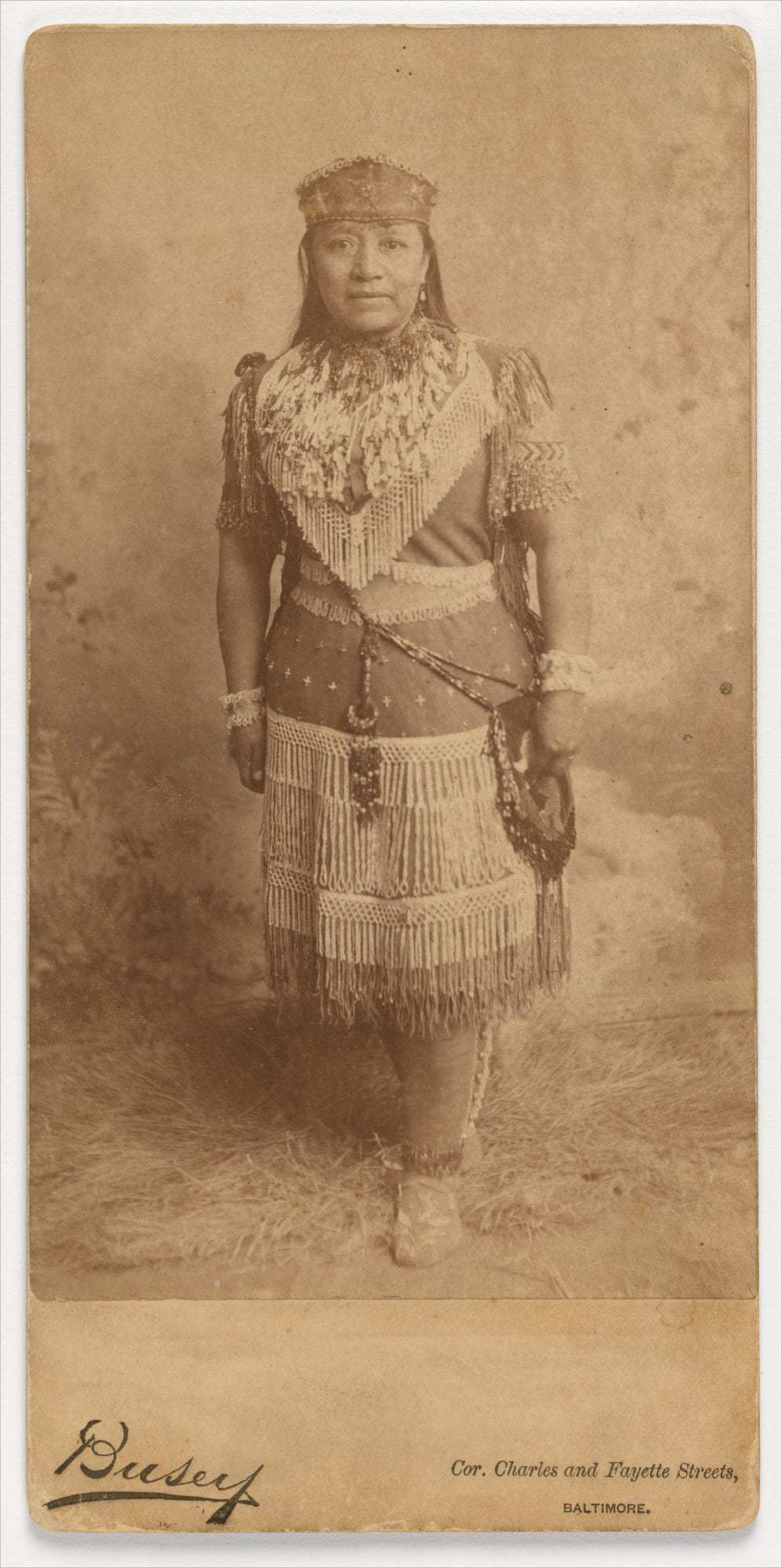
With the book’s publication, Sarah lectured nationwide on the lessons and experiences that she wrote about. In these presentations, Sarah wore her tribal dress and, to some’s surprise, demonstrated a good command of English. She was charming, made people laugh, and appealed to the audience for help in improving relations. In one speech, Sarah said,
“The proverb says the big fish eat up the little fishes and the Indians are the little fish and you eat us all up and drive us from home. Where can we poor Indians go if the government will not help us? If your people will help us, and you have good hearts...I will promise to educate my people and make them law-abiding citizens…It can be done—it can be done.”
Sara’s book also reveals some of her more personal thoughts and feelings. In a reflection about her grandfather, who struggled with the emotions of wanting peace but experienced distance and detriment from Americans, and how her life has mirrored the same, Sarah wrote:
“I can imagine his feelings, for I have drank deeply from the same cup. When I think of my past life, and the bitter trials I have endured, I can scarcely believe I live, and yet I do; and, with the help of Him who notes the sparrow’s fall, I mean to fight for my down-trodden race while life lasts.”
Sarah’s final years were spent in diligent work, continuing to lecture while trying to establish a school for Paiute children that offered instruction in English, but without demanding the abandonment of native identity as other schools around the country required. The effort proved challenging. Funding and support were inconsistent, in part because of her increasingly fragile health, which some believe came from work-related exhaustion.
Sarah passed away at the age of 47.
Note: shop our latest print product — a Langston Hughes quote bookmark.
Sources:
Brimlow, George F. “The Life of Sarah Winnemucca: The Formative Years.” Oregon Historical Quarterly, vol. 53, no. 2, 1952, pp. 103–34. JSTOR, http://www.jstor.org/stable/20612063. Accessed 22 Dec. 2025.
Carpenter, Cari M., and Carolyn Sorisio, editors. “East, 1883–1884.” The Newspaper Warrior: Sarah Winnemucca Hopkins’s Campaign for American Indian Rights, 1864-1891, University of Nebraska Press, 2015, pp. 149–219. JSTOR, https://doi.org/10.2307/j.ctt1d98c1z.9. Accessed 22 Dec. 2025.
Hopkins, Sarah Winnemucca. Life Among the Piutes: Their Wrongs and Claims. United States, G. P. Putnam’s Sons, 1883.
Photograph of Sarah Winnemucca taken by Norval Hamilton Busey in 1883. National Portrait Gallery, Smithsonian Institution, https://npg.si.edu/object/npg_NPG.82.137
Rosinsky, Natalie M.. Sarah Winnemucca: Scout, Activist, and Teacher. United States, Compass Point Books, 2005.
“Sarah Winnemucca.” National Park Service, https://www.nps.gov/people/sarah-winnemucca.htm